

The Flying Elephant Memoirs of an Olympic Champion: Life, Career, and Legacy
The Flying Elephant: Memoirs of an Olympic Champion is a sports memoir centered on Alexander Savin, one of the most notable Soviet volleyball players of his generation. Savin competed at the highest level of international volleyball and was part of the Soviet teams that won Olympic silver at Montreal 1976 and Olympic gold at Moscow 1980. The English edition gives readers a chance to look beyond those medals and understand the work, people, pressure, and personal experiences behind an elite athletic career.
For American readers who may know little about Soviet-era volleyball, the book is especially interesting because it connects one athlete’s life with a much larger story. It touches on youth development, professional training, international competition, teamwork, coaching, Olympic pressure, and the challenge of finding meaning after a sports career ends.
Current listings identify the English edition as a 514-page Kindle book. Recent descriptions also report a large collection of archival photographs, making the book more than a written sports story. It can also be viewed as a record of a period in volleyball history that is not always familiar to modern English-speaking readers.
What Is The Flying Elephant Memoirs of an Olympic Champion?
The Flying Elephant Memoirs of an Olympic Champion is the life story of Alexander Savin, a former Soviet volleyball star and Olympic champion. The memoir follows his journey from childhood and early volleyball training to elite competition, Olympic experiences, and life after professional sports.
The book goes beyond Savin’s medals and focuses on the hard work behind his success. It explores training, coaching, teamwork, discipline, pressure, setbacks, and the dedication needed to reach the Olympic level.
Savin’s story also gives readers a personal view of Soviet volleyball during one of its strongest periods. For sports and Olympic fans, the memoir offers both an athlete’s personal journey and a look at an important era in international volleyball.
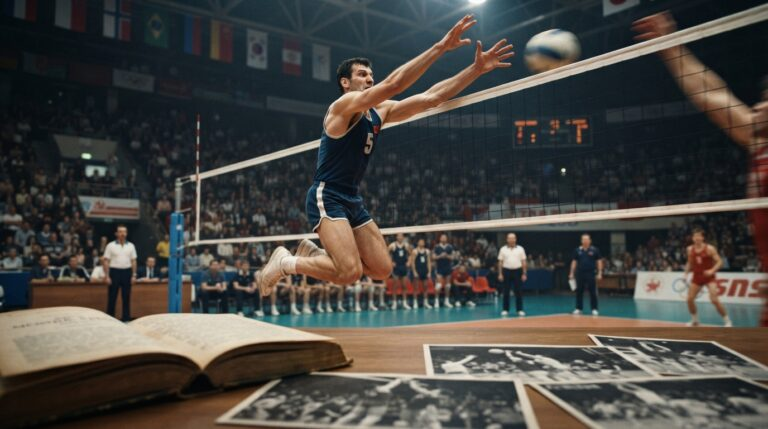
The Early Life and Athletic Development of Alexander Savin
Every Olympic champion has a starting point, and Savin’s story began long before the Olympic podium.
Accounts of his life describe his early development in the Soviet Union and his introduction to volleyball as a young athlete. He eventually entered the organized Soviet sports system, where promising players could receive intensive coaching and compete at increasingly higher levels.
This part of an athlete’s life is easy to overlook.
Fans often see the finished player. They see the powerful attack, the perfectly timed block, or the medal ceremony. They do not see the younger player learning basic movement, making mistakes, repeating drills, and slowly developing confidence.
That is one reason a memoir can be more valuable than a list of career achievements.
It shows that elite performance has a long beginning.
Savin’s development also demonstrates the importance of environment. A talented young athlete needs coaches who can identify potential and teach the right skills. The athlete also needs opportunities to compete against stronger opponents.
In other words, champions are rarely created by talent in isolation.
They develop through a combination of personal effort and the systems around them.
How Volleyball Shaped Savin’s Identity
Volleyball was not simply Savin’s profession. It became a major part of his identity.
For an elite athlete, the sport can influence almost every part of daily life. Training determines the schedule. Competition affects travel and relationships. Coaches influence decisions. Teammates become close companions. Wins and losses can affect confidence.
This creates an unusual lifestyle.
Also Read: Çbiri: Meaning, Origin, Language, and Complete Guide
A normal person may be able to separate work from personal life. An Olympic athlete often cannot make that separation so easily.
The athlete eats, sleeps, trains, travels, competes, recovers, and prepares according to the demands of the sport.
Savin’s memoir is valuable because it allows readers to think about this hidden side of athletic life.
The important question is not only, “How did he win?”
It is also, “What kind of life was required to become someone capable of winning?”
That distinction makes the story more human.
Why the Title The Flying Elephant Is So Memorable
The phrase “The Flying Elephant” immediately creates curiosity.
An elephant is usually associated with size, strength, and weight. Flying suggests the opposite: lightness, movement, and freedom.
Put those two ideas together and the result is a memorable image.
The nickname is connected with Savin’s physical presence and his ability to move and jump effectively despite his large frame. Volleyball requires players at the net to react quickly, jump, change direction, and read an opponent’s attack.
For a middle blocker, being large is useful, but size alone is not enough.
A player must also be fast.
That contrast helps explain why the nickname worked so well. Savin could appear physically imposing while still moving with the timing and athletic ability required at the highest level.
But there is another way to interpret the title.
The flying elephant can represent an achievement that initially appears impossible.
An elephant is not supposed to fly. Yet the image becomes believable once we stop thinking about the physical impossibility and start thinking about what the metaphor represents.
The same idea applies to an Olympic dream.
At the beginning, an Olympic gold medal can seem impossibly far away. Years later, after thousands of hours of training, the impossible can become a real outcome.
That is perhaps the strongest symbolic meaning of the title.
The Road From Training to Olympic Competition
The distance between a promising player and an Olympic champion is enormous.
Elite athletes must survive several stages of development. They must improve their physical abilities, technical skills, tactical understanding, and mental control at the same time.
For volleyball players, this is particularly demanding because the sport is highly technical.
A player must understand positioning, timing, blocking, attacking, serving, defense, and communication. At the international level, these skills must work under extreme pressure.
Savin’s career demonstrates how long-term development can create this level of performance.
His Olympic story did not begin in 1980.
It began years earlier.
Every training session, every competition, every coach, and every difficult experience contributed to the player who eventually stepped onto the Olympic court.
This is one of the most useful lessons for readers outside sports.
People often judge success by the final result. The memoir encourages a different perspective: judge success by the process that creates the result.
Alexander Savin and the 1976 Montreal Olympics
The 1976 Montreal Olympics were an important chapter in Savin’s international career.
The Soviet men’s volleyball team won the silver medal, placing second in an Olympic competition that featured some of the strongest teams in the world.
For an athlete, Olympic silver can produce mixed emotions.
It is an extraordinary achievement. At the same time, reaching a final and losing can leave a powerful feeling of disappointment.
That tension is one of the most interesting parts of elite sport.
The public often sees a silver medal as success. The athlete may remember the final differently.
Both views can be true.
A second-place finish can prove that an athlete belongs among the world’s best while also creating motivation to improve.
For Savin, the 1976 Olympic experience became part of the path toward the next major goal.
This is where the memoir can be read as more than a collection of memories. It shows how failure and success can exist together.
Silver was not the end of Savin’s Olympic story.
Four years later, the result would be different.
The 1980 Moscow Olympics and Olympic Gold
The 1980 Moscow Olympics occupy a special place in Savin’s career because the Soviet team won the gold medal on home soil.
Savin was part of that championship team, making him an Olympic champion as well as a previous Olympic silver medalist.
Winning at home created an unusual environment.
The expectations were enormous. The Soviet Union was competing on its own territory, and sport carried considerable national importance during the Cold War.
For an athlete, that means the pressure is not limited to the scoreboard.
There is the pressure of spectators, coaches, teammates, national expectations, and personal ambition.
Winning Olympic gold therefore required more than physical ability.
The players had to function as a team when the emotional pressure was at its highest.
This is an important insight from Savin’s career: Olympic success is rarely an individual achievement in a team sport.
One player can make an important block or attack, but the championship depends on everyone.
The Golden Era of Soviet Volleyball
To understand The Flying Elephant properly, readers should understand the volleyball environment in which Savin competed.
The Soviet Union had a powerful volleyball tradition, and its men’s national team was highly successful during the period when Savin played.
This was also an era in which sports could have political meaning.
The Cold War divided international politics into competing blocs, and sporting events sometimes became symbolic contests between those systems.
That does not mean every athlete thought about politics during every match.
Athletes were still athletes. They trained, competed, joked with teammates, dealt with injuries, and tried to win.
But the larger environment mattered.
A volleyball match involving the Soviet Union could carry a significance that went beyond volleyball.
This historical background gives the memoir additional value for American readers. It offers a perspective on an era when international sports were deeply connected to the wider world.
What Made Savin Effective as a Middle Blocker?
Savin’s position is important for understanding his career.
The middle blocker works near the center of the net and plays a critical role in stopping opposing attacks. The position requires strong timing, quick reactions, good reading of the game, and the ability to move efficiently along the net.
Height and reach are valuable, but they are not enough.
A blocker can be tall and still be ineffective if the timing is poor.
This is where Savin’s nickname becomes even more meaningful.
The “elephant” represents physical power and size.
The “flying” represents movement, jumping, timing, and athletic ability.
Together, the two words describe the combination required to excel at the position.
This is also a useful lesson about specialization.
Great athletes are not simply good at everything. They understand the specific demands of their role and develop the qualities that make them valuable within a team.
The Importance of Daily Training
One of the strongest ideas connected with Savin’s story is the value of repetition.
Elite performance looks impressive during competition, but it is usually built through ordinary work.
A perfect block may take only a fraction of a second.
The training needed to perform that block correctly may take years.
This creates a strange reality in sports.
The most important work is often the least exciting work.
Athletes repeat movements. They practice technique. They work on strength. They study opponents. They make mistakes and try again.
None of this looks dramatic from the outside.
But repetition creates reliability.
When the pressure rises, athletes cannot stop and think through every movement. Their training must already be built into their reactions.
That principle applies far beyond volleyball.
A musician practices scales.
A writer practices writing.
A surgeon practices procedures.
A business professional develops skills through repeated experience.
The lesson is simple: excellence is usually the result of ordinary actions performed consistently for a very long time.
The Role of Coaches in Savin’s Career
No elite athlete develops alone.
Coaches influence technique, strategy, discipline, confidence, and career direction.
A good coach does more than tell a player what to do. A good coach identifies what the player needs to become better.
Savin’s career developed inside a highly organized sports environment, where coaching was an important part of athlete development.
This creates another valuable lesson from the memoir.
Athletes need correction.
That can be difficult because talented people sometimes become comfortable with what they already do well.
A coach can identify weaknesses that the athlete cannot see.
The best relationship between athlete and coach is therefore not simply about praise. It is about honest feedback.
That idea remains relevant in modern sports, business, education, and personal development.
Teamwork Behind an Olympic Championship
One of the easiest mistakes when reading an Olympic memoir is to focus only on the central character.
Volleyball makes that difficult.
Unlike individual sports, volleyball requires constant cooperation.
Players must trust each other.
They must communicate.
Also Read:Pulsamento: What It Is and Why It Matters
They must understand positioning.
They must recover quickly after mistakes.
They must know when to attack and when to support.
A great individual performance cannot compensate for a team that does not function together.
This is why Savin’s story has value for readers interested in leadership.
Leadership in a team is not always about being the loudest person.
Sometimes leadership means being reliable.
Sometimes it means performing your role consistently.
Sometimes it means helping teammates recover after a mistake.
The strongest teams often contain players who understand that personal success and team success are connected.
What The Memoir Says About Pressure
Pressure is a major part of elite competition.
For an ordinary athlete, losing a game can be disappointing.
For an Olympic athlete, a single match can represent years of preparation.
That difference changes the emotional experience.
The athlete knows that an opportunity may not return for another four years.
The public may expect victory.
Teammates depend on each other.
Coaches have made plans around specific players.
Under those conditions, confidence becomes extremely important.
But confidence is not simply believing that you are talented.
Real competitive confidence comes from preparation.
When an athlete has practiced a skill thousands of times, there is something solid to rely on when the pressure rises.
This is one of the most practical lessons readers can take from Savin’s career.
Confidence is easier to maintain when it has evidence behind it.
Failure Is Part of the Champion’s Story
A common problem with sports biographies is that success can make the story look too simple.
The athlete wins.
The athlete becomes famous.
The story ends.
Real careers are rarely that clean.
Savin’s Olympic record itself shows why.
He experienced silver before gold.
That sequence matters.
The 1976 result did not make him a failure. It became part of the experience that preceded later success.
This offers a healthier way to understand failure.
A setback does not automatically mean that a person lacks ability.
Sometimes it reveals what still needs to improve.
Sometimes it creates experience that becomes valuable later.
The important question is not whether someone has failed.
Everyone fails.
The more useful question is what happens afterward.
The Human Side of an Olympic Champion
Medals can make athletes seem larger than life.
Memoirs bring them back to earth.
Behind every champion is a person dealing with ordinary emotions.
There can be excitement, fear, frustration, tiredness, pride, disappointment, friendship, and uncertainty.
This is why personal stories often connect with readers more strongly than statistics.
You can understand that someone won an Olympic gold medal in one sentence.
But understanding what it meant to live through the years leading to that medal requires a much longer story.
That is where a memoir becomes valuable.
The reader gets a chance to see the person behind the achievement.
The Flying Elephant as a Historical Record
The book has value beyond personal inspiration.
It helps preserve memories of a specific period in volleyball history.
Sports history can disappear surprisingly quickly.
Players who were famous decades ago may become unknown to younger fans. Teams change. Rules evolve. Training methods change. Political systems disappear.
Personal memories help preserve what official records cannot fully capture.
A statistics page can tell us who won.
It cannot always tell us what the team culture was like.
It cannot explain how players experienced travel, training camps, friendships, or pressure.
It cannot fully preserve the small stories that make a sporting era feel alive.
That is why athlete memoirs can become historical sources as well as entertainment.
What Makes The Flying Elephant Different From a Typical Sports Biography?
Many sports biographies follow a familiar formula.
A young athlete has a dream.
The athlete struggles.
The athlete becomes successful.
The athlete wins something important.
The reader receives an inspirational conclusion.
The Flying Elephant can be understood differently.
Its greatest value is not simply the final achievement.
The interesting part is the combination of sport and history.
Savin’s career developed within the Soviet sports system, during the Cold War, during a particularly successful period for international volleyball.
That gives the story multiple layers.
It is about one athlete.
It is about a team.
It is about volleyball.
It is about Olympic competition.
And it is about a particular historical period.
That wider context makes the memoir more useful to readers who want to understand how sports and society can influence each other.
Life After Competitive Volleyball
An athlete’s story should not end when the final match ends.
Retirement can create a difficult transition.
For years, an athlete knows exactly what the main goal is.
Train.
Compete.
Improve.
Win.
Then suddenly that structure disappears.
Life after sport therefore requires a new identity.
Savin continued to have a connection with volleyball after his playing career, including work connected with coaching and athlete development.
That continuation is important because experience does not have to end with retirement.
A former athlete can become a coach.
A former competitor can become a mentor.
A champion can preserve history by sharing memories.
In that sense, the end of playing can become the beginning of another form of contribution.
The Lasting Legacy of Alexander Savin
Savin’s legacy rests on more than his Olympic gold medal.
His career represents an important period in international volleyball.
His Olympic record includes silver in 1976 and gold in 1980. His international achievements extended to major world and European competitions, and his later induction into the International Volleyball Hall of Fame recognized his contribution to the sport.
But legacy is not only about awards.
Also Read: Antarvafna: Understanding Inner Awareness and Self-Reflection
A player’s influence can survive through stories.
It can survive through photographs.
It can survive through former teammates.
It can survive through coaches and younger athletes.
And it can survive through books.
That is why The Flying Elephant is important.
It gives a later generation a way to encounter a champion who competed in a sporting world that no longer exists in the same form.
Conclusion
The Flying Elephant: Memoirs of an Olympic Champion is ultimately a story about much more than volleyball.
It is about becoming.
Alexander Savin did not become an Olympic champion in one afternoon. His career was shaped over many years through training, competition, coaching, teamwork, setbacks, and persistence.
His 1976 Olympic silver medal and 1980 Olympic gold medal provide the most visible milestones, but the deeper story is everything that happened between them and around them.
The unusual title captures that story well. The “elephant” represents strength and physical presence. The “flying” represents athletic ability, movement, ambition, and the achievement of something that can initially seem impossible.
For American readers, the memoir also offers a valuable introduction to a different chapter of Olympic and volleyball history.
Most importantly, it reminds us that champions are not created by medals.
The medal is the final evidence.
The real story is the work that came before it.
That is what makes The Flying Elephant worth exploring. It gives readers a chance to look beyond the Olympic podium and see the person, the team, the era, and the years of effort behind one of volleyball’s memorable careers.
Frequently Asked Questions
Is The Flying Elephant based on real events?
Yes. The book is presented as Alexander Savin’s memoir, meaning it is based on his own life and experiences as an elite volleyball player.
When was the English edition of The Flying Elephant published?
Current online listings and descriptions identify the English edition as a recent publication, with sources placing its release in October 2025. Readers should check the current retailer listing for the latest edition information.
How long is The Flying Elephant?
The current Amazon Kindle listing reports a print length of 514 pages. Digital page counts can vary depending on reading settings and edition details.
Does the book include historical photographs?
Yes. Current descriptions of the English edition report more than 240 photographs, including archival material connected with Savin’s life and volleyball career.
Where can readers find the English edition?
The English Kindle edition is currently listed by Amazon. Availability, pricing, and regional access can change, so readers should check the current listing before purchasing. The Flying Elephant: Memoirs of an Olympic Champion on Amazon